Greenhouse Climate Optimizer → AI
An LLM-orchestrated planning service that refines greenhouse climate setpoints.
- Python
- FastAPI
- LangChain
- Docker
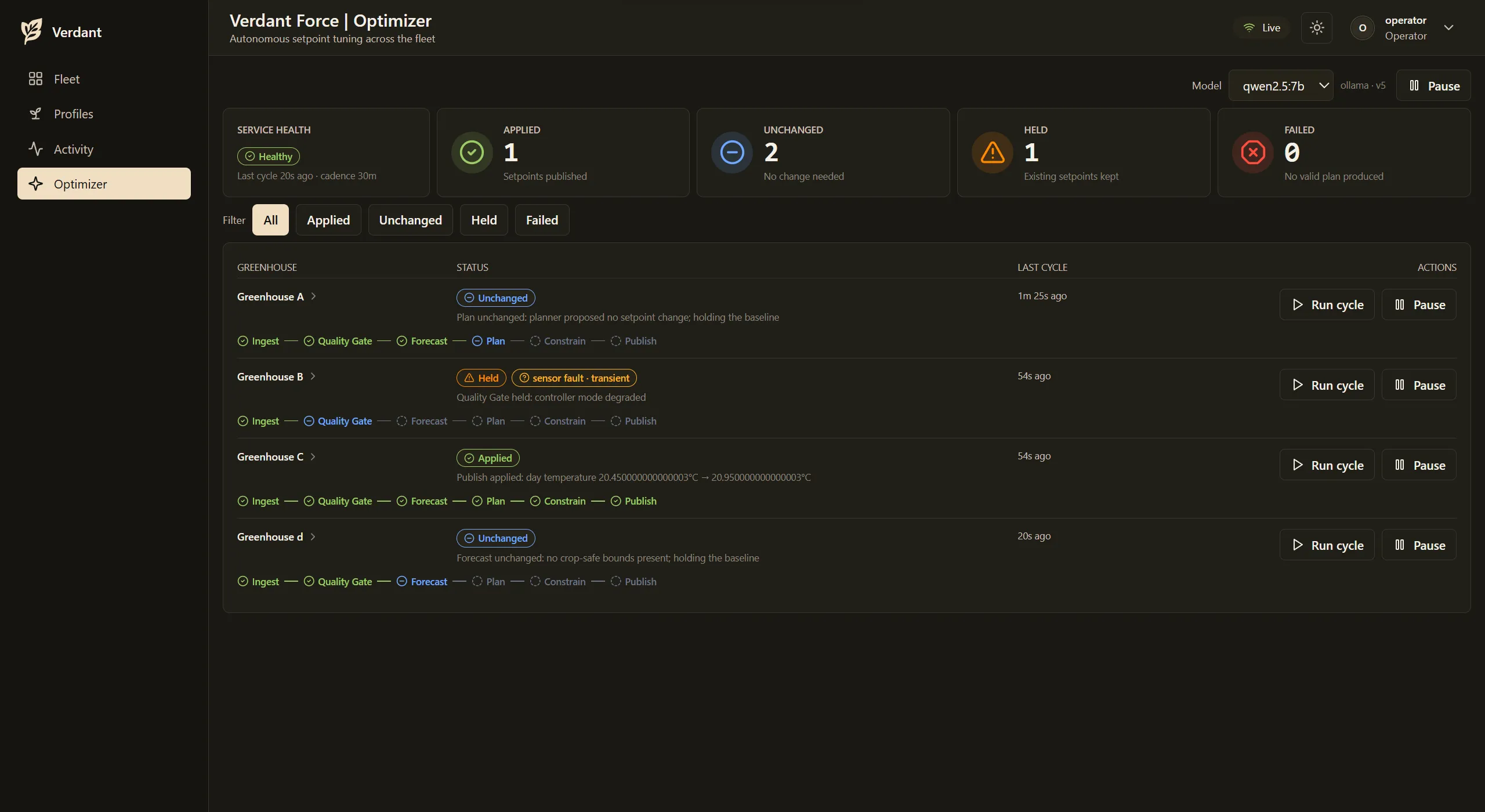
Problem
Greenhouse climate targets are coupled decisions, not independent thermostat settings. A temperature adjustment can affect humidity and VPD; ventilation can trade cooling for lost CO₂; and a plan that looks plausible in isolation can still be inappropriate for the crop, the current greenhouse state, or the live system’s health.
I built the optimizer as a planning layer for the greenhouse platform. It reads the platform’s bounded planning context, projects the greenhouse forward with a digital twin, and asks an LLM for a structured setpoint-refinement plan. The optimizer can improve targets, but it never commands actuators, writes directly to a controller, or bypasses controller safety interlocks.
Complexity
AI Without Operational Authority
An LLM can offer useful synthesis and rationale, but its output must not become an unreviewed control command. The system therefore treats the model as one stage in a larger deterministic pipeline. Data-quality gates decide whether it is safe to plan at all; a digital twin establishes the expected trajectory; and a constraint engine decides whether the proposed refinement can be applied.
| Risk | Design response |
|---|---|
| Stale, incomplete, or faulted telemetry | Hold the current platform baseline and record a held outcome instead of planning from untrusted inputs. |
| Hallucinated or malformed model output | Require a versioned structured plan contract, then validate the candidate before it reaches the write path. |
| Crop-unsafe or inconsistent targets | Check crop-safe bounds and cross-field consistency in a deterministic constraint engine. |
| Optimizer or platform failure | Keep the last accepted setpoints in force; the edge controller continues local climate control and safety enforcement. |
| Repeated failures | Record a failed outcome without changing intended setpoints; the next scheduled cycle can retry from the current baseline. |
Planning Across a Live Fleet
The scheduler runs on a fixed 30-minute cadence, with cycles concurrent across greenhouses but single-flight within each greenhouse. That gives a fleet useful parallelism without allowing two optimizer runs to race over one greenhouse’s setpoints. A state-change gate also suppresses an LLM call when the new twin forecast is materially unchanged from the last planning forecast, avoiding unnecessary cost and target churn.
Architectural Design
A Digital Twin to Forecast Trajectory
The Python twin uses a seeded, first-order model of coupled greenhouse dynamics to project temperature, humidity, CO₂, and light over the planning horizon. It is deliberately an explainable planning model rather than a claim of perfect agronomic fidelity. The service checks divergence and sustained prediction residuals; when the twin no longer tracks reality well enough, it withholds the plan and makes that limitation observable.
A Guarded Planning Pipeline
Each cycle begins with the platform’s current setpoints, telemetry history, actuator health, freshness signals, faults, and crop-safe bounds. The optimizer models the baseline trajectory before it asks the planner for bounded deltas. The candidate plan is then validated independently of the LLM and either submitted through the platform’s existing setpoint API or recorded as held or failed with the existing baseline unchanged.
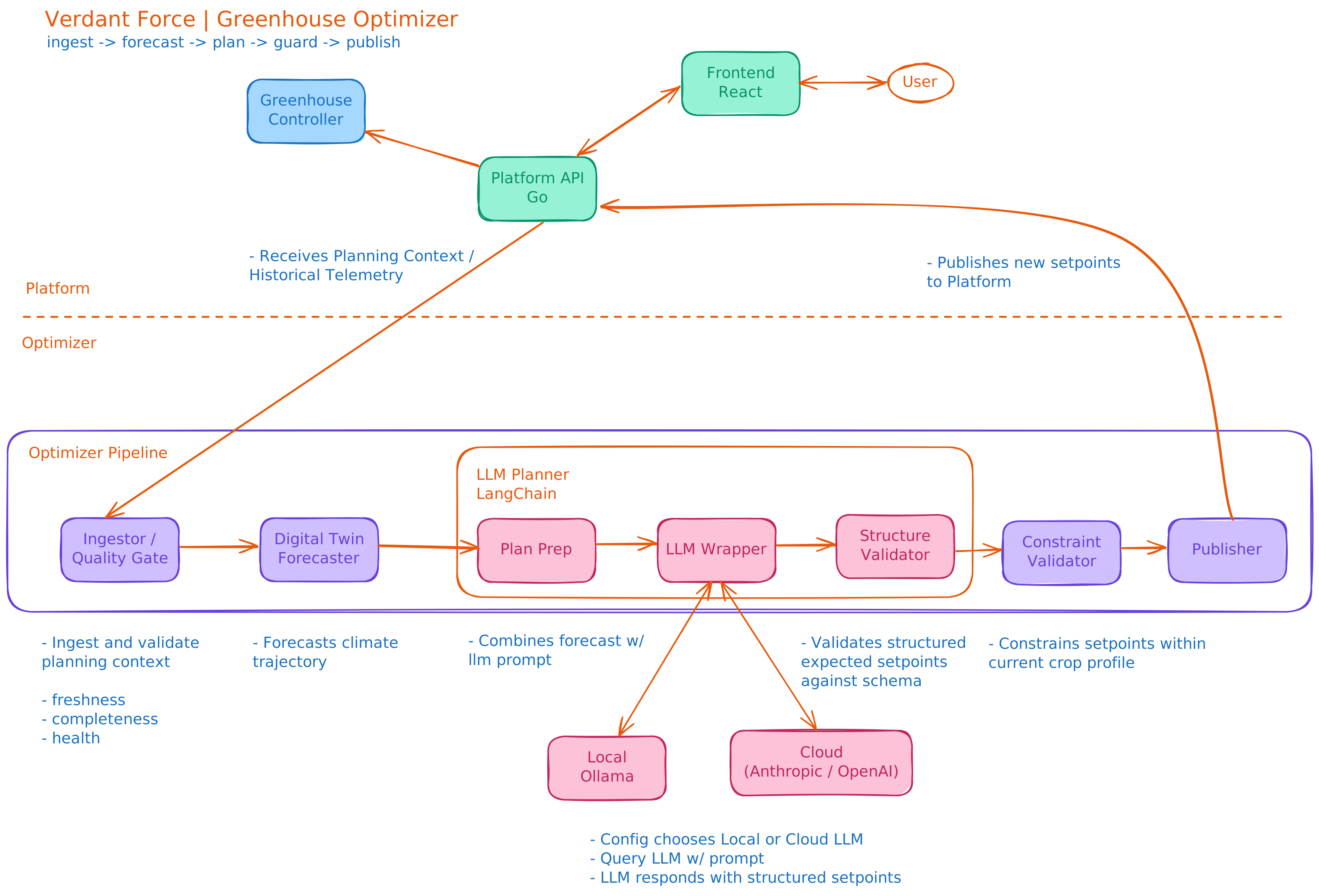
The guarded planning pipeline: forecast and LLM proposals pass through deterministic gates before the platform receives a setpoint refinement.
read planning context → input gate → simulate forecast → state-change gate
→ LLM structured plan → constraints + confidence gate → outcome
  applied → platform setpoint write
  held / failed → baseline unchanged
The platform remains the single authority for intended setpoints and delivers them to the controller. The controller, in turn, owns actuator commands, slew limits, and live safety interlocks. This makes an optimizer outage a loss of refinement, not a loss of climate control.
Where the Optimizer Fits
The optimizer is one product in a deliberately bounded three-part system.
| Component | Responsibility | What it cannot do |
|---|---|---|
| Climate optimizer | Read bounded planning context, forecast likely outcomes, and propose validated setpoint refinements. | Write directly to a controller, command actuators, or override crop-safe and safety gates. |
| Platform | Register greenhouses, retain intended state, validate accepted refinements, and deliver setpoints through the shared write path. | Command individual actuators or bypass controller safety. |
| Climate controller | Run local control loops, enforce interlocks, command actuators, and publish telemetry. | Depend on the optimizer or platform to continue protecting the crop. |
The optimizer reads its planning context from the platform and submits only a bounded refinement through the platform’s API. The platform decides whether to accept and reconcile that refinement, then delivers intended setpoints to the controller. Telemetry, health, faults, and actual controller state flow back through the platform for the next planning cycle.
Inspectable Outcomes
Every branch yields a plan record rather than disappearing into logs. Each record includes an optimizer run ID and a canonical status and reason. When the planner produces a candidate, the record also captures its rationale, confidence, model, and prompt version. The FastAPI service exposes health, plan, and fleet data through the platform’s operator-facing proxy, where a user can inspect the proposed setpoint diff and latest planning outcome.
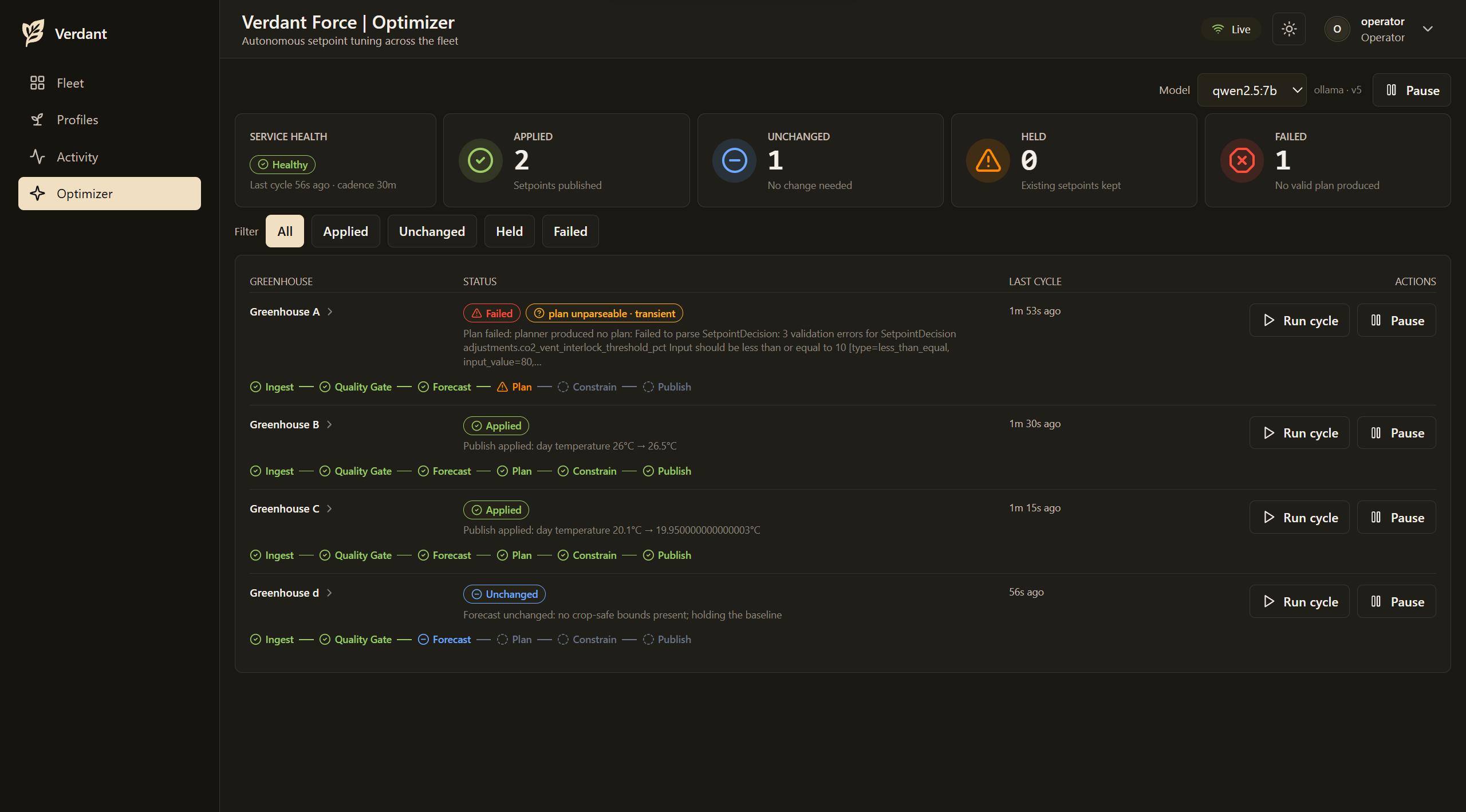
A failed planning outcome remains visible to the operator while the existing platform baseline stays in effect.
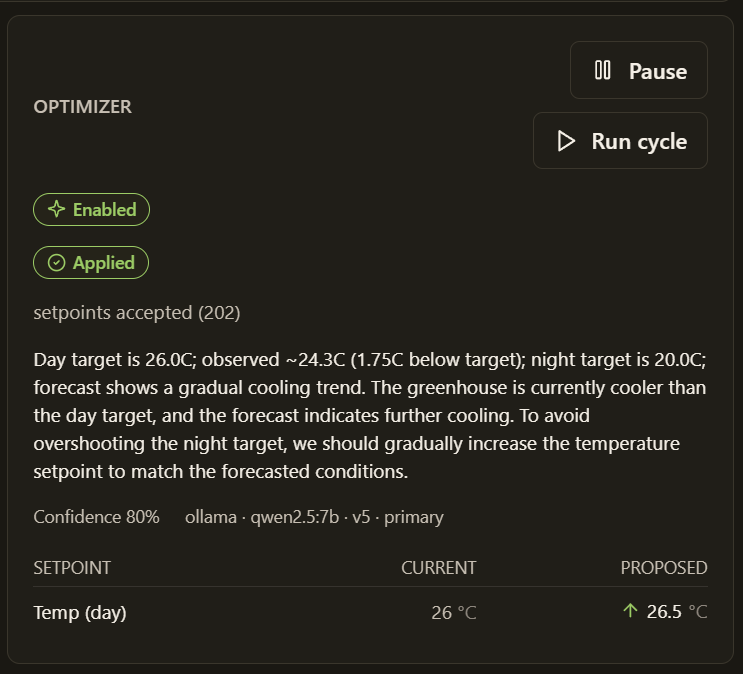
The greenhouse detail view surfaces the latest optimizer plan, its status, and the resulting setpoint changes.
Architectural Tradeoffs
| Choice | Why it fit | Tradeoff |
|---|---|---|
| Python instead of Go or C# | Its numerical, validation, and LLM ecosystems fit the planning layer. | More dependency and runtime overhead than Go or C#. |
| LangChain instead of custom LLM orchestration | Provides prompt composition, structured output, and provider routing. | Adds framework dependency and reduces low-level control. |
| LLM proposes setpoint deltas, not actuator commands | Keeps the flexible reasoning layer inside a narrow, reviewable authority boundary. | The optimizer cannot directly optimize low-level actuator behavior. |
| Deterministic gates around the LLM | Makes data trust, bounds, confidence, and application outcomes testable. | More pipeline stages and failure states than a direct model-to-controller integration. |
| Local Ollama by default, cloud models optional | Supports an offline, key-free local stack while retaining a configurable path to stronger hosted models. | Local inference can be slower and less capable for complex plans. |
| In-memory plans and outcomes | Keeps the service simple and makes restart behavior explicit; Phase 2 remains authoritative for setpoints. | Operational history inside the optimizer is not durable across a restart. |
| Platform-mediated writes | Preserves one audited setpoint authority and prevents direct optimizer-to-controller coupling. | Adds a network boundary and reconciliation work to every accepted plan. |
Outcome
The result is an LLM-orchestrated planning service with deliberately limited power. It turns recent greenhouse behavior into an explainable, bounded refinement of climate targets, while unsafe, stale, low-confidence, or failed planning paths leave the existing baseline in place and remain visible to an operator.
It delivers:
- digital-twin forecasts and state-change-aware planning
- versioned, structured LLM plans with prompt and model traceability
- deterministic freshness, health, constraint, and confidence gates
- concurrent per-greenhouse scheduling without same-greenhouse write races
- held and failed outcomes that preserve the platform baseline rather than mutating intended state
- a platform-mediated write path that leaves actuator authority and final safety enforcement with the edge controller
Lessons Learned
The LLM planner provided quick initial development to reason setpoints from the digital twin’s forecast. However, it took a fair amount of extra effort downstream to refine the LLM’s prompt, manage hallucinations, manage token/compute usage and ensure that the output was structured and valid.
For this use case, the LLM integration was a useful experiment, but for production use, a more deterministic control strategy like MPC (model predictive control) is likely preferable. Determinism is king for control systems.
However, I would consider using an LLM to generate reports or assist operators with troubleshooting. Using it to either make sense of semantic language or generate semantic language from structured data is where LLMs really shine.
Code entry points
github.com/brokhuli/greenhouse-climate-controller
-
climate-optimizer/src/climate_optimizer/orchestration/cycle.py— Planning-cycle orchestration -
climate-optimizer/src/climate_optimizer/domain/twin.py— Digital twin and fidelity checks -
climate-optimizer/src/climate_optimizer/domain/constraints.py— Constraint and application gate -
climate-optimizer/src/climate_optimizer/planner— LLM planning chain -
climate-optimizer/src/climate_optimizer/infra/dataaccess.py— Platform read and write client -
climate-optimizer/src/climate_optimizer/orchestration— Scheduler and plan-outcome lifecycle