Greenhouse Climate Controller → Edge/IoT
A deterministic Rust edge controller that turns greenhouse sensor data into safe, local climate actions.
- Rust
- MQTT
- REST
- Docker
Problem
Greenhouse control is not a collection of independent thermostats. Heating can change humidity, opening a vent can cool the air while flushing CO₂, and grow lights add both usable light and heat. A controller has to respond to those coupled effects without trusting every sensor or assuming its upstream services are available.
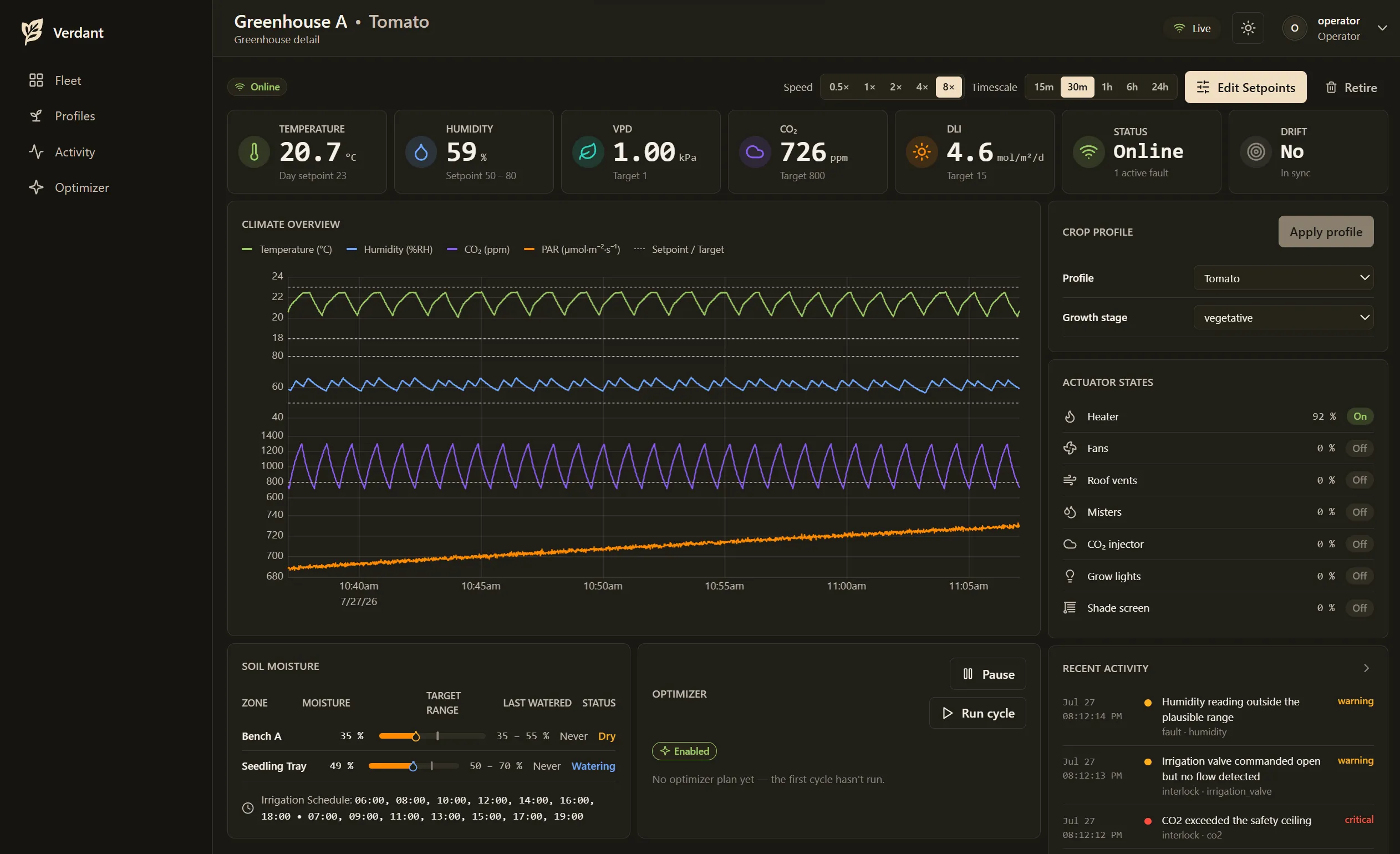
I built the climate controller as the local, deterministic control product in a larger greenhouse platform. It reads temperature, humidity, CO₂, light, and per-zone soil moisture; resolves crop targets; and operates heaters, fans, vents, misters, irrigation, CO₂ injection, lights, and shade.
The important constraint was local authority: the greenhouse must keep sensing, deciding, and protecting the crop even if the dashboard, database, or MQTT broker is unavailable. The controller therefore owns the real-time edge loop and safety behavior rather than delegating either upstream.
Complexity
Coupled Control at the Edge
The system runs a fixed 1 Hz pipeline. Every tick consumes a consistent sensor snapshot and completes its decision before the next begins. That predictability matters: it gives the controller a clear order of operations, a bounded path to an interlock response, and telemetry that describes a committed state rather than work in progress.
| Dimension | Design response |
|---|---|
| Coupled climate variables | A simulated plant models delayed, cross-variable actuator effects: vents, fans, lights, and misters affect more than one outcome. |
| Unreliable inputs and outputs | Three temperature probes use median voting; sensor faults, actuator readback divergence, and no-response conditions are detected and surfaced. |
| Conflicting intent | Control loops propose actions, manual overrides may replace them, safety interlocks override both, and actuator limits shape the final command. |
| Headless operation | Telemetry publishing is decoupled from control, so a slow or disconnected broker creates an observable data gap rather than stopping climate control. |
Safety Is an Ordering Problem
Safety is not a separate alert after an actuator decision. It is part of the command path. A critical-temperature or CO₂-ceiling condition takes final priority over normal control and a manual override. The controller also enforces slew rates and minimum on/off cycles, with safe moves allowed to bypass dwell when waiting would be harmful.
The controller may accept an operator’s target, but it never accepts an operator’s authority to bypass a local safety interlock.
That rule prevents the rest of the system from accidentally becoming a remote hardware-control surface.
Architectural Design
A Deterministic Control Pipeline
The Rust controller separates domain logic from I/O behind a hardware abstraction layer (HAL). The current HAL is a seeded simulation with first-order-lag dynamics and hidden disturbances, but the control pipeline only knows how to read sensors and write actuator commands. A real hardware module can implement the same boundary without rewriting the control logic.
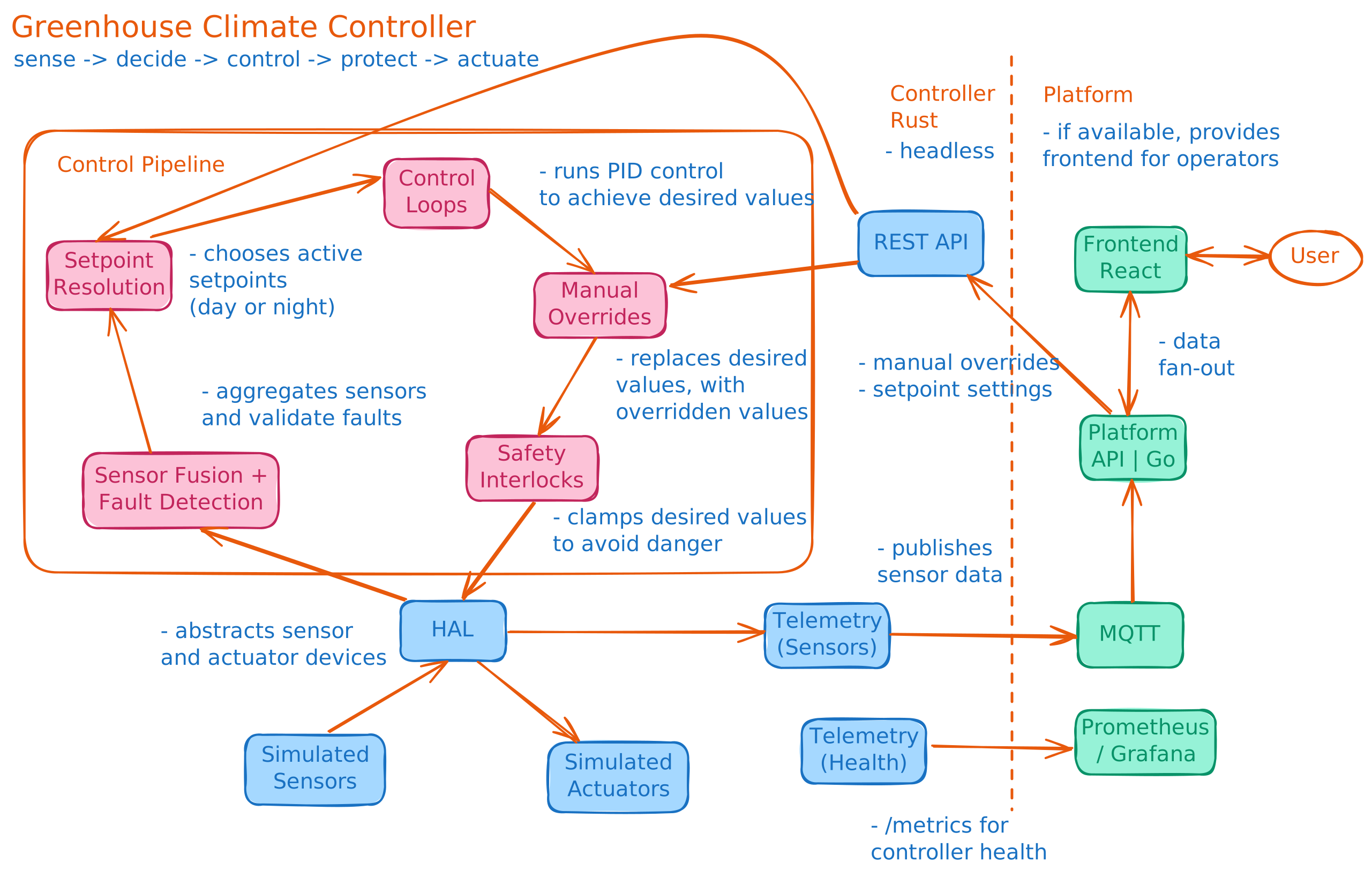
The controller architecture: state moves forward through one fixed-tick pipeline, and safety has the final say before commands reach the HAL.
The pipeline is deliberately simple to reason about:
sense + validate → resolve setpoints → control loops → manual override
→ safety interlocks → actuator constraints → command plant → publish snapshot
This sequence makes several decisions explicit:
- Temperature uses PID control with anti-windup; humidity derives an RH target from VPD and uses a hysteresis band; CO₂ enrichment stops while vents are open; irrigation is independently scheduled and moisture-gated per zone.
- Temperature sensing uses three probes, so one bad reading can be excluded without losing control. When readings or actuator behavior cannot be trusted, affected loops fail closed or hold a safe state instead of guessing.
- Every REST write is latched for the next tick. MQTT is telemetry-only and publishes the post-tick snapshot, so neither can mutate a decision halfway through the pipeline.
- Manual overrides expire automatically and remain downstream of the loops but upstream of safety. They are useful for local diagnostics without becoming a permanent, unsafe operating mode.
Where the Controller Fits
The controller is one product in a deliberately bounded three-part system.
| Component | Responsibility | What it cannot do |
|---|---|---|
| Climate controller | Sense locally, run control loops, enforce interlocks, command actuators, and publish telemetry. | Surrender safety authority or rely on cloud/platform availability to keep controlling. |
| Platform | Register greenhouses, ingest MQTT telemetry, persist and present fleet state, resolve crop-profile intent, and reconcile setpoints over REST. | Command individual actuators or override controller safety. |
| Optimizer | Read bounded planning context and propose safe refinements to setpoints. | Write to a controller directly, command actuators, or override the controller’s interlocks. |
The platform is the single setpoint authority. Operators use its greenhouse detail page, and the optimizer submits its refinements to the same platform write path. The platform then delivers the intended setpoints to a controller over REST. In the other direction, the controller publishes readings, actuator state, faults, and system state over MQTT for the platform to ingest and stream to the UI.
That separation is intentional: an optimizer outage leaves the platform’s baseline targets in place, and a platform or broker outage leaves the local controller operating safely. Each layer can add value without becoming a single point of failure for crop protection.
Verification Through Simulation
The simulator is not just a demo layer. Given the same seed, initial state, and command log, it produces the same sequence of ticks. That made it practical to test behavioral scenarios that would be hard or risky to reproduce against a physical greenhouse:
- a temperature-probe outlier is rejected while the other probes sustain control
- total temperature disagreement holds a safe state
- an unresponsive irrigation valve disables only its affected zone
- critical temperature forces cooling within the next tick
- open vents suppress wasteful CO₂ enrichment
- a forgotten manual override expires and returns authority to the controller
The same contract-shaped telemetry and REST payloads are used at the system boundary, so the simulator, platform, and dashboard integrate against the same interfaces as the controller itself.
Architectural Tradeoffs
| Choice | Why it fit | Tradeoff |
|---|---|---|
| Rust instead of C++, Go, or C# | It provides predictable native performance and memory safety without a garbage collector, making the controller’s ownership, concurrency, and fault paths explicit. | C++ has a deeper embedded ecosystem, while Go and C# can be quicker for teams already fluent in their managed runtimes; Rust adds a steeper learning curve and more deliberate modeling up front. |
| Fixed 1 Hz tick instead of event-driven control | A single cadence makes ordering, replay, telemetry, and interlock latency easy to reason about for this slow-moving physical domain. | It is not suitable for sub-second actuator control without changing the scheduling model. |
| Coupled first-order simulation instead of full greenhouse physics | It creates realistic lag and actuator interaction while remaining deterministic and testable. | It is a control test harness, not a high-fidelity agronomic model. |
| Local safety authority instead of platform-mediated actuation | The controller keeps protecting the greenhouse through network, broker, and platform failures. | Upstream services must influence the house indirectly through setpoints. |
| MQTT telemetry and REST writes as separate paths | The split makes observation fan-out simple and prevents the broker from becoming a command dependency. | It requires explicit contracts and reconciliation rather than a single bidirectional protocol. |
| HAL trait instead of coding directly to the simulator | It isolates control logic from device I/O and creates a path to real hardware. | The abstraction adds interfaces and simulator maintenance before physical hardware exists. |
Outcome
The result is an inspectable edge controller, not a dashboard mockup. It runs a complete greenhouse decision cycle locally: trusted sensing, climate and irrigation control, fault detection, safety interlocks, actuator constraints, and telemetry publication.
It delivers:
- deterministic, seed-replayable control and fault scenarios
- local operation that continues through MQTT or platform outages
- redundant temperature sensing and actuator-health checks
- crop-protective interlocks that cannot be bypassed by remote intent
- a clean MQTT/REST boundary that integrates with the platform dashboard
- a setpoint-only seam for the optimizer, without giving it actuator or safety authority
Most importantly, the boundaries make the whole system easier to trust: the platform makes controller behavior visible and manageable, the optimizer can improve targets, and the controller remains the last local authority on what is safe to do inside the greenhouse.
Code entry points
github.com/brokhuli/greenhouse-climate-controller
-
climate-controller/src/pipeline.rs— Fixed-tick control pipeline -
climate-controller/src/hal/sim.rs— Hardware abstraction and simulator -
climate-controller/src/control— Climate control loops -
climate-controller/src/safety/interlocks.rs— Safety interlocks -
climate-controller/src/rest.rs— Controller REST API -
climate-controller/src/mqtt.rs— MQTT telemetry publisher -
climate-controller/tests/scenarios.rs— Deterministic safety scenarios