CBTC Train Simulator → Digital Twin
Greenfield modernization of real-time train simulator for V&V and customer delivery.
- C#
- .Net
- Modular Monolith
- Blazor
- GraphQL
- Docker
- Playwright
Professional Disclaimer
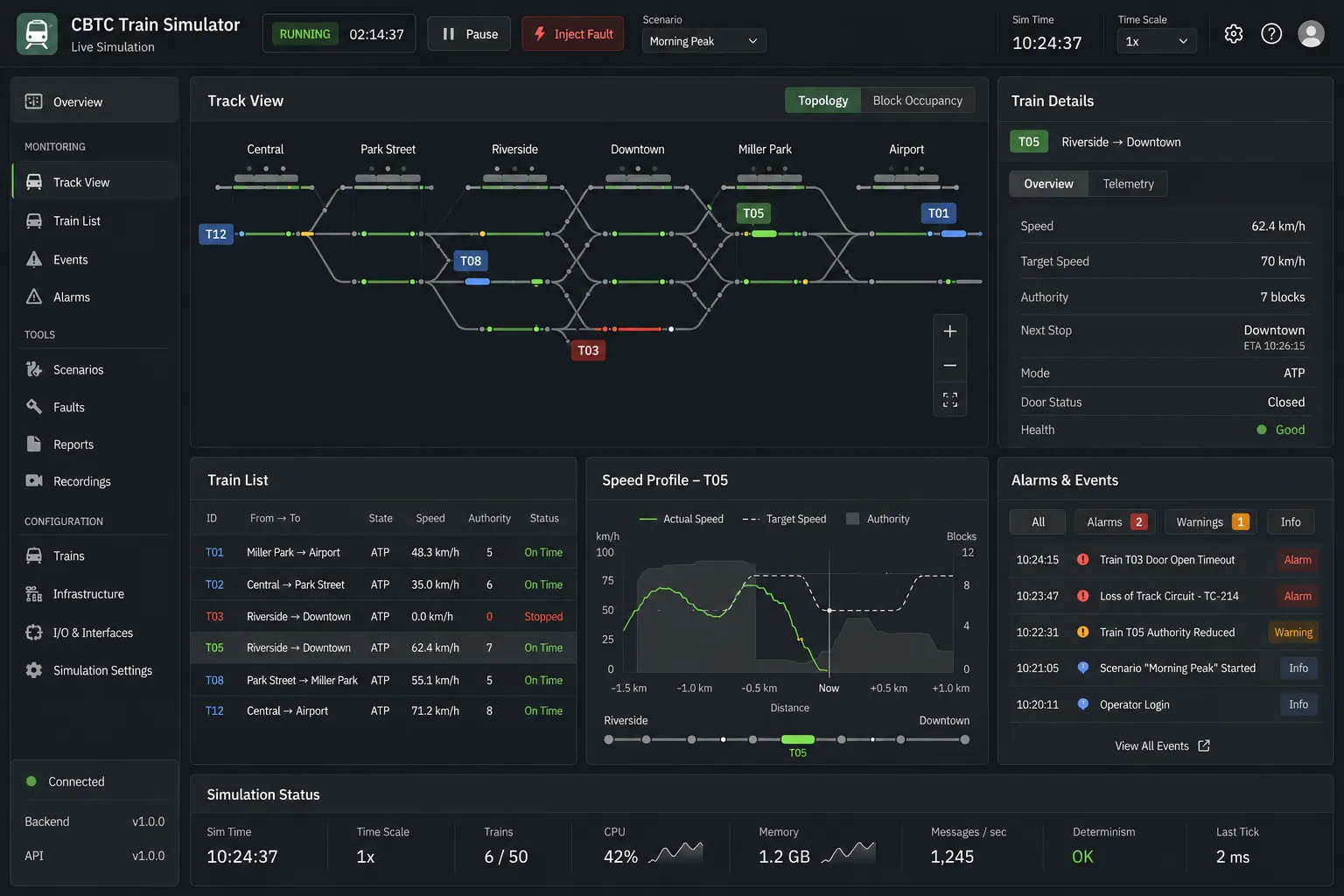
This was a product I led as Software Architect and Product Manager for Alstom Transportation’s simulation team. I don’t own the codebase, so this case study stays at the architectural level. No code, no proprietary diagrams. Internal module names, and sensitive details have been intentionally omitted or generalized. The screens shown are illustrative only.
Background
CBTC (Communications-Based Train Control) is the signaling system that runs modern metro lines. It decides where every train is allowed to move, and how fast. The simulator stands in for real trains so that signaling software can be tested, verified, and trained on without putting hardware on a track. It generates virtual trains, runs realistic kinematics, and talks to wayside signaling systems the same way real rolling stock would.
Two groups depend on it:
- Integration and V&V teams — testing wayside signaling software before it ships to a transit authority.
- Customers — running operator-training systems that look and behave like the real line.
For the train nerds out there, this is moving block CBTC.
Problem
I inherited a long-lived, monolithic product with code dating back to the early 2000s. Decades of iterative additions to support successive signaling projects had left the architecture difficult to extend without unintended side effects.
| Symptom | Consequence |
|---|---|
| Highly coupled architecture | Small changes routinely broke unrelated features. |
| Limited automated testing | Regressions were caught later in the cycle than ideal. |
| Simulation fidelity gaps | Downstream integration teams spent extra effort reconciling behavior. |
| Dedicated Windows hardware required | No path to containerized or cloud deployment. |
| Heavy maintenance footprint | Sustaining effort was disproportionate to feature throughput. |
Goals
I set the following targets with leadership alignment. They were as much about the business as the codebase:
- Reduce sustaining effort so the team could shift toward new work.
- Improve simulation fidelity to reduce downstream integration friction.
- Containerize for cloud deployment.
- Productize core simulation and allow for extensible project-specific logic.
- Accelerate feature delivery for new signaling projects.
- Improve the integration/V&V user experience.
Complexity
The hard parts weren’t any single component, they were the constraints that had to hold simultaneously:
- Deterministic real-time core. — Same inputs must produce the same outputs, while still allowing users to inject faults and interact live.
- Behavior beyond the written spec. — Capturing the full operational behavior required going past the written requirements and reconciling them with observed system behavior in integrated environments.
- Clean Internal and External Boundaries. — Promoted testability, maintainability, and extensibility for project-specific logic, and a clean contract for telemetry and UI clients.
My Role
As Lead Software Architect I owned the technical direction of the rewrite end to end.
| Mine | Delegated to the team |
|---|---|
| Technical leadership | Physics engine lead |
| Roadmap, strategy, vision | Backend-to-frontend architecture |
| Overall architecture | User experience discovery |
| Translating domain reqs → software design | Frontend component design and implementation |
| Prototyping core backend components | CI/CD, automated testing |
| Backend feature development | |
| Physics engine support and guidance | |
| Code review |
Architectural Design
High-Level Approach
A greenfield build, not a piecemeal modernization. The legacy product’s tight coupling and accumulated technical debt made incremental refactoring more expensive than a clean rewrite. The new product was built on a modular monolith using a hybrid of Domain-Driven Design and Hexagonal Architecture including clean boundaries between data model, simulation, and transport.
Backend
The backend owns everything that matters: state, timing, logic, and the simulation contract. The frontend is a viewer.
The codebase is organized into three concentric layers: datamodel, simulation, and API. The following shows an illustrative layout, not the actual directory structure.
/src
  /DataModel          ← pure data, no behavior
    /Models
    /Interfaces
    /Controllers
  /SimulationModel
    /PhysicsModels
  /SimulationLogic    ← orchestrated by a simulation engine
    /<behavior-1>
    /<behavior-2>
    /...
  /Api
    /GraphQL
    /IntegrationApi
Key properties:
- Pure data model. — Models hold data, not logic making them trivially testable and reusable.
- Simulation engine. — Schedules logic sequences with separate timing budgets with tight deterministic loops where physics demands it, and looser cadences for non-critical logic, freeing CPU where it matters.
- Headless capable. — Backend runs without the UI, which unlocked containerized deployment and automated V&V.
Frontend
After user discovery with integration and V&V engineers, the frontend was redesigned around visual context rather than the prior form-with-labels approach. Blazor renders a 2D track view showing trains in motion where users see simulation state at a glance instead of decoding numeric fields effectively improving user context and accelerating workflows.
The frontend queries the backend over GraphQL. The backend doesn’t push updates, it exposes a complete query and command surface, so any client (UI, telemetry, test harness) can consume the same contract without backend changes.
Observability
Simulation faults produce a packaged snapshot: structured logs plus frontend screenshots capturing the system state at the moment of failure. Snapshots ship to developers and dramatically shorten investigation time.
CI/CD and Testing
- Unit tests against the pure data model and isolated simulation logic.
- Playwright end-to-end tests covering full simulation scenarios.
- CI/CD pipelines automating build, test, and deploy.
Architectural Tradeoffs
| Choice | Why it fit | Tradeoff |
|---|---|---|
| Greenfield over piecemeal modernization | Legacy coupling and technical debt made incremental refactor more expensive than rewrite. | Higher upfront investment; required parallel maintenance of the old product during transition. |
| Modular monolith over microservices | One product, one team, no inter-service scaling need. Easier to troubleshoot issues. | Less independent packaging and deployability of subsystems. |
| DDD + Hexagonal hybrid | Clean domain boundaries, testable seams, and ubiquitous language for non-technical stakeholders. | More upfront design discipline than a layered/Clean approach. |
| C# over C++ | Leveraged the team’s existing .NET expertise. | Less determinism in tight physics loops than C++ would allow. With today’s AI-assisted tooling, I’d pick C++. |
| Blazor over WPF/Qt | A web frontend was the unlock for containerization and cloud deployment with no OS license per VM. | Less native UI ergonomics than Qt or WPF for an instrument-like view. |
| Blazor over React/Angular/Vue | Reused the team’s .NET background and kept application logic on the server side, consistent with the team’s existing operational model. | Server model requires a stable backend connection. |
| GraphQL over REST | One flexible contract that telemetry, UI, and test harnesses can all query without backend changes. | More schema design work upfront; pull model means clients are responsible for keeping their views fresh. |
Outcome
The rewrite shipped and was well received by both the engineering teams who depend on it and the leadership group that sponsored it.
Measurable Results
The new product delivered:
| Metric | Result |
|---|---|
| Maintenance effort | Reduced |
| Runtime performance | Improved |
| Feature delivery velocity | Faster |
| Mean time to resolution | Faster |
| Simulation accuracy | Improved |
| Dedicated hardware / OS licensing per deployment | Eliminated |
The product moved from an aging, infrastructure-constrained platform to a containerized, testable, observably-behaving system that the broader signaling organization could rely on.